Pharmaceutical warehouse setup in Dubai involves multiple layers of regulatory approval from federal licensing to local fire safety certification making early planning essential for distributors, importers, and healthcare logistics providers entering the UAE market. Whether you’re launching a new facility or expanding an existing one, understanding the full compliance picture before signing a lease can save months of avoidable delays.
Here’s a number that catches many new operators off guard: medications can begin degrading within 48 hours once temperatures climb above 25°C and Dubai’s outdoor temperature regularly tops 45°C for four months of the year. That means a single weekend power outage, or a loading dock without proper climate control, isn’t just an inconvenience. It can quietly destroy an entire shipment and put your license at risk before you even realize something went wrong.
Why Pharmaceutical Warehouse Setup in Dubai Requires Two Regulatory Layers
Operating a pharmaceutical warehouse in Dubai means satisfying both federal and emirate-level requirements. At the federal level, the Ministry of Health and Prevention (MOHAP) alongside the newly established Emirates Drug Establishment (EDE) oversees the medical warehouse license required to import, store, and distribute pharmaceutical products across the UAE. This federal framework was substantially updated by Federal Decree-Law No. 38 of 2024, which came into force on 2 January 2025 and replaced the previous Federal Law No. 8 of 2019. At the emirate level, the Dubai Health Authority (DHA) and Dubai Municipality apply additional local conditions covering facility location, building use, and zoning, so a warehouse cannot legally operate in Dubai until both layers of approval are secured.
MOHAP Medical Warehouse License: Step-by-Step Process
Securing a pharmaceutical warehouse license Dubai authorities will recognize starts with a clear federal sequence: applying for pre-licensing approval through the MOHAP e-services portal using UAE Pass, submitting the facility for an initial inspection and paying the associated fee, and receiving initial approval once the inspection clears. From there, applicants coordinate remaining requirements with other government departments most notably Dubai Civil Defence and apply for staff licensing, since the MOHAP medical warehouse license UAE process requires every facility to designate a MOHAP registered pharmacist as its Responsible Person. Only after a final inspection and final approval is the license fee paid and the license issued electronically. Medical warehouse applicants are specifically expected to meet the technical and health conditions outlined in Circular No. 90 of 2021, which remains in force as an executive regulation under the new law.
GDP and Storage Requirements for Pharmaceutical Warehouses in Dubai
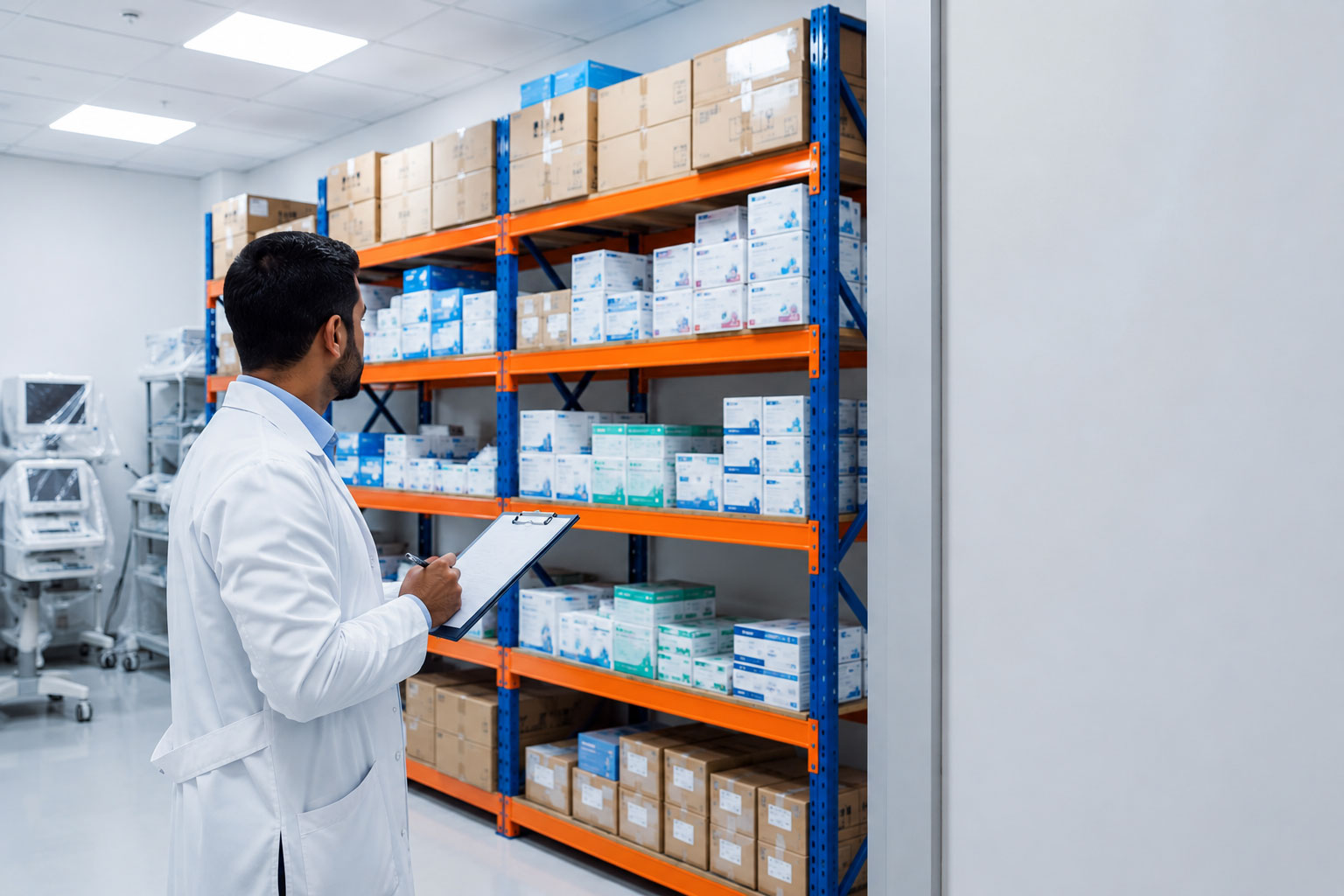
Meeting GDP pharmaceutical warehouse Dubai expectations means going beyond the license application itself. MOHAP inspectors also assess whether the facility reflects Good Storage Practice (GSP) and Good Distribution Practice (GDP) principles, aligned with the World Health Organization’s GDP guidelines (Technical Report Series No. 1025, Annex 7). In practice, the pharmaceutical warehouse requirements UAE operators are generally expected to meet include a dedicated storage area starting around 50 square metres for smaller operations (200+ square metres for larger distributors), clearly separated temperature zones ambient storage roughly between 15°C and 25°C and cool storage between 2°C and 8°C for refrigerated products and a distinct quarantine area for returned, damaged, or expired stock.
Essential Equipment for Pharmaceutical Warehouse Setup in Dubai
A compliant pharmaceutical warehouse setup in Dubai depends on the right equipment as much as the right paperwork. At the centre of reliable cold chain pharmaceutical storage Dubai facilities need are pharmaceutical-grade refrigerators or cold rooms maintaining 2°C to 8°C (with ultra-low units down to -20°C or -80°C for specialised products such as vaccines), continuous 24/7 temperature data loggers, and backup generators or UPS systems to protect refrigeration during power outages a requirement Dubai’s summer heat makes non-negotiable. Engineered racking and shelving keep stock organised and traceable, while validated temperature mapping documentation gives inspectors evidence that conditions remain within range across the entire storage area, not just at a single sensor point. Industry compliance reviews consistently point to incomplete cold chain documentation as the most common reason pharmaceutical warehouse applications are rejected on first submission.
Dubai Civil Defence and Fire Safety Requirements
Dubai Civil Defence warehouse approval is required for every commercial facility, including pharmaceutical warehouses, under the UAE Fire and Life Safety Code of Practice. This generally requires a full fire alarm system, automatic sprinklers, emergency lighting, and fire-rated compartmentation. Facilities that also store flammable or hazardous materials alongside pharmaceutical stock may additionally need gas suppression systems using agents such as FM-200 or NOVEC 1230, since water-based sprinklers are unsuitable for some chemical and electronic storage areas.
Common Compliance Pitfalls to Avoid
Most delays in pharmaceutical warehouse setup in Dubai come from a handful of recurring issues: starting Civil Defence approval too late instead of running it in parallel with MOHAP inspection, appointing a Responsible Person who isn’t actually available on-site during inspections, underestimating the quarantine and temperature-zone space needed once racking and equipment are installed, and assuming a license issued in one emirate automatically covers operations in another. Each of these is avoidable with early planning and a clear pre-inspection checklist.
How Trust Health Consultancies Supports Your Warehouse Setup
Trust Health Consultancies guides distributors and healthcare investors through every stage of pharmaceutical warehouse setup in Dubai — from MOHAP and DHA documentation to facility readiness ahead of inspection. If your project also involves sourcing compliant medical equipment or coordinating wider authority approvals, our team can manage these in parallel so your facility is ready to operate without unnecessary delays.
Frequently Asked Questions
How long does MOHAP medical warehouse license UAE processing typically take?
Timelines vary by facility readiness, but most applicants move from pre-licensing approval to final license issuance within roughly 2 to 4 months, assuming inspections pass on the first attempt and Civil Defence approval is secured in parallel.
What is the difference between MOHAP and DHA approval for a pharmaceutical warehouse?
MOHAP issues the federal medical warehouse license required to import, store, and distribute pharmaceutical products anywhere in the UAE, while the Dubai Health Authority and Dubai Municipality apply Dubai-specific conditions on location, zoning, and facility use before the warehouse can legally operate within the emirate.
What temperature range is required for pharmaceutical cold storage in the UAE?
Most pharmaceutical products are stored at controlled ambient temperatures of 15°C to 25°C, while refrigerated products such as vaccines and biologics require 2°C to 8°C, monitored continuously with validated data loggers in line with GDP compliance.