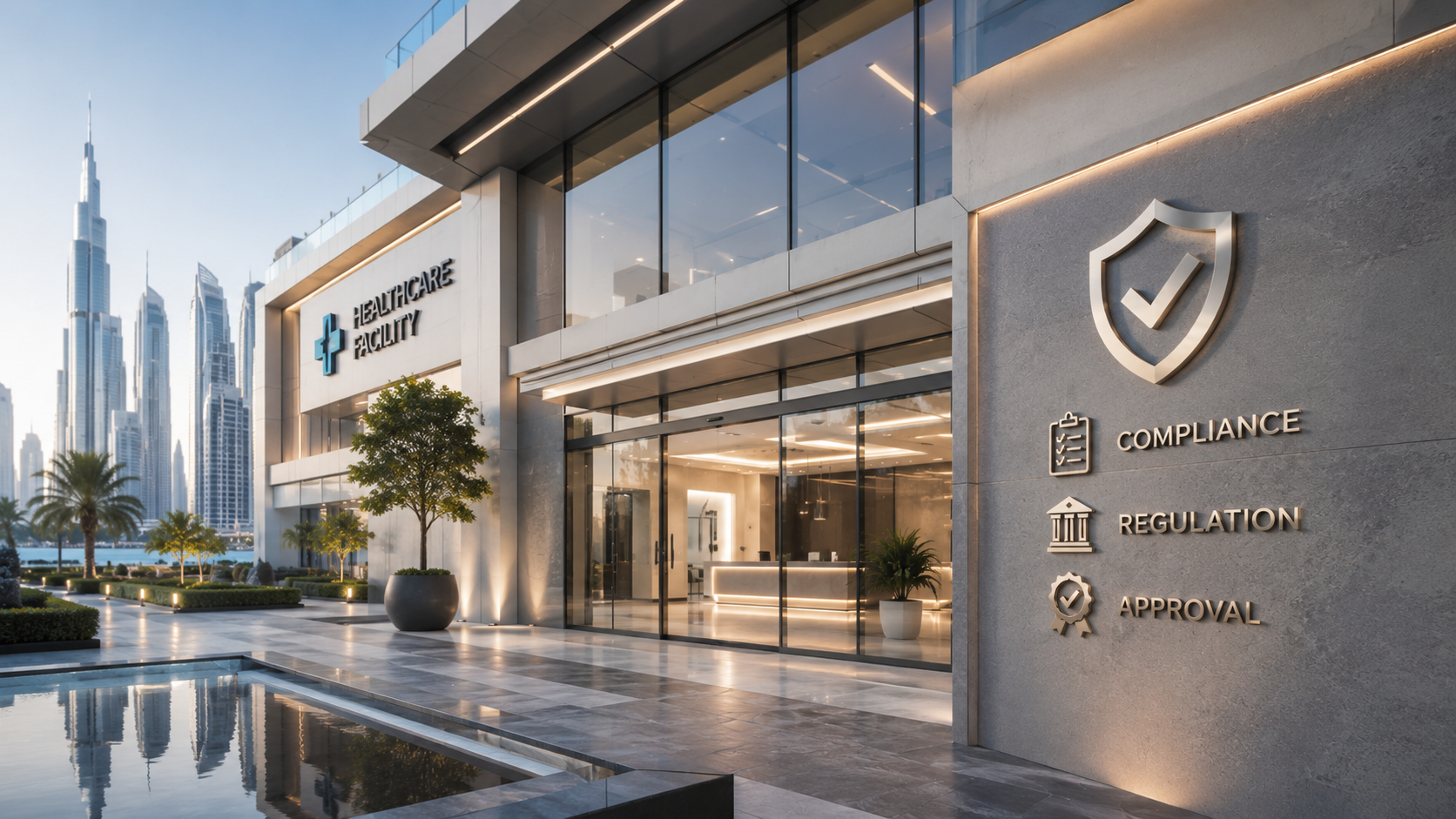
Healthcare facility licensing UAE is not a single national process. Instead, it is managed through several regulatory authorities, each responsible for specific emirates and operating under its own framework, digital platforms, standards, and approval procedures.
For investors, one of the most important early decisions isn’t simply selecting a specialty or location. It’s determining which regulatory authority will oversee the project, as this affects licensing requirements, timelines, inspections, and ongoing compliance.
Healthcare facility licensing UAE requirements are regulated by four primary authorities depending on the location of the facility:
- Dubai Health Authority (DHA) for healthcare facilities in Dubai outside Dubai Healthcare City (DHCC).
- Department of Health – Abu Dhabi (DOH) for healthcare facilities across Abu Dhabi.
- Ministry of Health and Prevention (MOHAP) for healthcare regulation across several Northern Emirates.
- Sharjah Health Authority (SHA) for healthcare facility licensing and regulatory services within Sharjah.
Each authority operates its own licensing framework, digital services, technical standards, inspection procedures, and professional licensing requirements. As a result, two identical healthcare projects may follow different approval processes depending on where they are established.
Regardless of the jurisdiction, healthcare investors generally need both:
- a commercial license issued by the relevant economic authority; and
- a healthcare facility license issued by the competent health authority.
Managing these processes in parallel often helps reduce delays during project establishment.
Dubai Health Authority (DHA)
DHA regulates healthcare facilities throughout Dubai outside Dubai Healthcare City. Licensing applications are processed through the Sheryan electronic system, which manages facility licensing, professional licensing, inspections, and regulatory approvals.
Department of Health – Abu Dhabi (DOH)
DOH regulates all healthcare facilities in Abu Dhabi through the TAMM digital platform. Depending on the type of healthcare services provided, facilities may also need to comply with additional requirements, including integration with the Malaffi health information exchange and approvals from other competent authorities where applicable.
Ministry of Health and Prevention (MOHAP)
MOHAP regulates healthcare facilities across several Northern Emirates under the applicable federal healthcare legislation. Licensing services are provided through MOHAP’s digital platforms, which support UAE PASS authentication and electronic application management.
Sharjah Health Authority (SHA)
Sharjah Health Authority provides healthcare facility licensing and regulatory services within the Emirate of Sharjah.
Investors can apply through SHA for an Initial Approval to establish or reopen a healthcare facility. Once construction, technical requirements, staffing, and inspections are successfully completed, the authority may issue a Permanent Healthcare Facility License in accordance with its licensing requirements.
Whether you’re pursuing a clinic license UAE authorities will accept depends entirely on which of these four bodies DHA, DOH, MOHAP, or SHA governs your chosen emirate.
Investors considering Dubai should also understand the distinction between Dubai mainland and Dubai Healthcare City (DHCC).
Unlike mainland Dubai, where facilities are regulated by DHA, healthcare providers operating within DHCC fall under the regulatory oversight of the Dubai Healthcare City Authority – Regulatory (DHCR).
DHCC was established as a specialized healthcare free zone offering a dedicated regulatory environment for healthcare providers, educational institutions, and research organizations.
One important consideration for investors is ownership structure. Free zones such as DHCC generally offer different investment and ownership frameworks compared with mainland businesses. As a general principle, free zones in the UAE have historically offered greater flexibility on foreign ownership compared to mainland structures — though investors should confirm current thresholds directly with DHCR or the relevant authority before establishing a healthcare facility.
Although licensing procedures differ among authorities, most healthcare facility licensing projects follow a similar sequence:
- Confirm which regulatory authority governs your intended location.
- Obtain commercial registration alongside the healthcare licensing process whenever possible.
- Prepare architectural layouts and engineering drawings that comply with the authority’s technical standards.
- Complete professional licensing requirements for healthcare practitioners and key management positions where applicable.
- Successfully complete authority inspections before final licensing approval.
- Review ownership, legal structure, and investment requirements at an early stage to avoid unnecessary restructuring later.
Getting healthcare facility licensing UAE requirements right from the first step choosing the correct authority saves investors significant time, cost, and restructuring later in the project.
Do all healthcare facilities require both commercial and healthcare licenses?
Yes. Healthcare facilities generally require a commercial license issued by the relevant economic authority together with a healthcare facility license issued by the competent health regulator.
Is a Medical Director required before opening a healthcare facility?
Many healthcare facilities are required to appoint an approved Medical Director as part of the licensing process. The exact requirements depend on the facility type and the regulations of the relevant health authority.
Is healthcare licensing different in Abu Dhabi and Dubai?
Yes. Each authority follows its own licensing procedures, digital platforms, inspection requirements, and regulatory standards. For example, Abu Dhabi processes licensing through TAMM, while Dubai uses the Sheryan system for facilities regulated by DHA.
Does Sharjah Healthcare City have a separate licensing process?
Healthcare facilities within Sharjah are licensed through the Sharjah Health Authority, including projects located within Sharjah Healthcare City, in accordance with SHA’s applicable licensing procedures.
Can foreign investors establish healthcare facilities in the UAE?
Yes. Foreign investors can establish healthcare businesses in the UAE, subject to the applicable ownership rules, licensing requirements, and investment regulations governing the chosen jurisdiction. Requirements may differ between mainland and free zone locations.
Getting healthcare facility licensing UAE requirements right from the first step choosing the correct healthcare authority UAE and securing the appropriate clinic license UAE regulations require saves investors significant time, cost, and restructuring later in the project.